
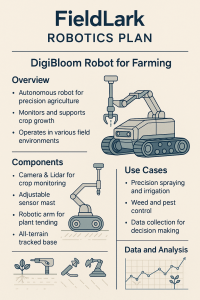

DigiBloom Scout™ – Micro-Field Mapping Bot
A gentle, sensor-dense rover that maps soil, crop, and microclimate conditions plant by plant.
Designed for small farms, teaching gardens, and accessibility-first agriculture.
Infographic preview
Overview
- Autonomous micro-field mapper
- Accessible design for disabled farmers
- Day-long patrol endurance
Sensors
- RGB+NIR camera & micro-LiDAR
- Soil moisture / EC / pH probes
- Weather microstation, IMU
Data
- Plant-level health indices
- Soil transect snapshots
- Upload to Sheets & Notion
Modes
- Scout patrols
- Soil study lines
- Education demos
Architecture – Mobility, Sensing, and Farm Integration
Mobility Platform
Compact 4-wheel or mini-track base tuned for raised beds and soft soil.
- Low ground pressure, zero-turn at low speed.
- Brushless or geared DC drive with encoders.
- Ingress protection target: IP54 → IP65 in later runs.
Sensor Mast & Soil Node
Telescoping mast with co-aligned camera and LiDAR, plus removable soil probes.
- RGB+NIR imaging for basic plant health indices.
- Solid-state LiDAR / depth for row following & obstacles.
- Soil moisture, EC, optional pH; air temp/humidity/pressure.
DigiBloom OS – Scout Profile
ROS-based autonomy with FarmHelper AI integration and a browser UI.
- Mapping, navigation, and route planning.
- Soil sampling routines with labeled transects.
- Exports to FarmHelper backend, Google Sheets, Notion.
Accessibility & Education
Built for Bunny’s Flowers and community farm programs.
- Friendly form factor, low operating noise.
- Visual and audio status cues, ADA-minded safety margins.
- Live dashboard for student experiments and demos.
Key Specifications – DigiBloom Scout v1
| Parameter | Target Spec |
|---|---|
| Form Factor | ~600 × 450 × 550 mm (L×W×H) with mast |
| Endurance | 8 hours mixed-duty patrol with 24 V / 20 Ah LiFePO₄ pack |
| Drive | 4-wheel or track drive, skid-steer; 0.2–0.4 m/s typical |
| Sensors | RGB+NIR camera, micro-LiDAR / depth, IMU, GNSS (optional RTK), soil moisture/EC/pH, temp/humidity/pressure |
| Compute | Jetson Orin Nano or Raspberry Pi 5 + STM32/Teensy motor MCU |
| Connectivity | Wi-Fi 6, optional LTE, optional LoRa telemetry |
| Data Outputs | FarmHelper AI, Google Sheets, Notion databases |
The Infinite Corridor
Building a Billion Classrooms from a Single Blueprint
The conventional “build everything at once” method (pre-generating a billion folders) creates massive cost, extreme slowness,
and digital waste. The Infinite Corridor reframes the system as on-demand creation: build one perfect blueprint, then mint
any classroom instantly when needed.
- The Problem: Pre-building everything upfront causes storage/labor blowups, slow deployment, and “fill dirt” data bloat.
- The Solution: A Virtual File System (VFS) holds one blueprint and spawns any classroom on request—like a video game rendering only what’s visible.
- The Outcome: Cost stays minimal, deployment is instant, and scale becomes exponential because logic is fixed while reach is effectively infinite.
- The Main Idea: A single rule can generate a billion worlds. Lean algorithmic design beats static infrastructure.
| Feature | Traditional Manual Folders | Infinite Corridor (Algorithm) |
|---|---|---|
| Setup Cost | High (storage + labor) | Minimal (rules/blueprint) |
| Time to Deploy | Slow (manual structuring) | Instant (minted on-demand) |
| Data Bloat | High (“fill dirt” files) | Near-zero (render only when needed) |
| Scalability | Linear (cost grows with size) | Exponential (fixed logic, infinite reach) |